




Money laundering is a global problem that affects economies and financial institutions. It involves the process of concealing the origins of illegally obtained money, typically by passing it through a complex sequence of banking transfers. Money launderers aim to make illegally obtained funds appear legitimate. It allows them to enjoy their ill-gotten gains. But without attracting the attention of law enforcement authorities. To combat money laundering effectively. Businesses and financial institutions must implement robust Know Your Customer (KYC) procedures. In this blog, we will explore what is money laundering, what is laundering money, what laundering money means and its consequences, and how KYC Square can help prevent it.
Understanding Money Laundering
What is the definition of Money Laundering? Here is the answer for what is money laundering, Money laundering is a clandestine process that criminals use to legitimize their ill-gotten gains.
It typically involves three key stages:
1) Placement:
In this stage, illegal funds are introduced into the financial system. This can be done through various means. Like depositing cash into bank accounts. And purchasing assets, or using the funds for transactions. That will generate legitimate-looking income.
2) Layering:
During this stage, the goal is to obscure the source of the funds. Criminals engage in a series of complex financial transactions. It is designed to create confusion and make it difficult to trace the money back to its illicit origins. This may include wire transfers, and buying and selling assets. And moving funds between accounts.
3) Integration:
Here the laundered money is reintroduced into the legitimate economy. It can be used to purchase assets, invest in businesses, or fund other legal activities. It is making it difficult for authorities to distinguish between legal and illegal wealth.
The consequences of money laundering are far-reaching. It fuels organized crime, terrorism, and corruption. It is undermining the integrity of financial systems and economies. It also erodes trust in financial institutions. And can have severe legal and reputational consequences for businesses. Many businesses are involved in unwittingly facilitating money laundering activities.
History of Anti-money Laundering Laws
Making funds obtained unlawfully (also known as “dirty money”) appear legitimate (sometimes known as “clean”) is the practice of money laundering. Three steps are usually involved: integration, layering, and placement. First, illegal money is sneakily injected into the banking system that is authorized. The funds are then transferred or wired between multiple accounts in an attempt to cause confusion. After a few more transactions, the “dirty money” is finally incorporated into the financial system and appears “clean.” Money laundering has a negative effect on the world economy and can help commit crimes like terrorism and drug trafficking.
The Financial Crimes Enforcement Network is the designated administrator of the Bank, with the goal of “protecting the financial system from the abuses of financial crime, including terrorist financing, money laundering, and other illicit activity.”
Since its founding in 1970, the BSA has grown to be one of the most crucial instruments in the battle against money laundering. Since then, a number of other legislation have improved and changed the BSA to give regulatory bodies and law enforcement the best resources possible to fight money laundering. Below is a chronological list of anti-money laundering laws enacted since 1970 along with their corresponding objectives and requirements.
The Role of KYC Square in Preventing Money Laundering
KYC Square is a critical tool in the fight against money laundering. Before fighting against it, learn about what is laundering money. It refers to the process by which businesses and financial institutions. It verifies the identity of its customers to ensure they are legitimate and not involved in illegal activities. KYC procedures are essential for detecting and preventing money laundering. It will be complying with anti-money laundering (AML) regulations.
Here you can create one in blog creative with the title:
What Does KYC Square Provide?
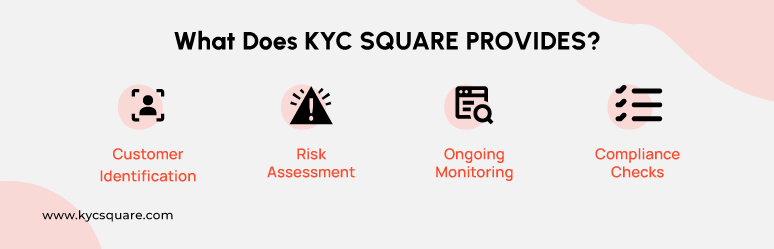
- Customer Identification
- Risk Assessment
- Ongoing Monitoring
- Compliance Checks
Take action against money laundering today with KYC Square. Protect your business, ensure compliance, and maintain trust. Get started now!
Key Components of KYC Square
Customer Identification: The first step in KYC Square is to verify the identity of customers. This includes collecting personal information. Like name, address, date of birth, and government-issued identification documents. Advanced KYC solutions also use biometric data. And facial recognition technology to enhance identity verification.
1) Risk Assessment:
Financial institutions and businesses must assess the risks associated. It is with each customer to determine the level of due diligence required. High-risk customers, such as politically exposed persons (PEPs). Those from high-risk jurisdictions may require additional scrutiny.
2) Ongoing Monitoring:
KYC Square is not a one-time process. Continuous monitoring of customer transactions and behavior. It is essential to detect any suspicious activity. Automated systems can flag unusual patterns or large transactions for further investigation.
3) Compliance Checks:
KYC Square also includes checks for compliance with AML regulations. This involves screening customers against sanction lists and watchlists. It is to ensure they are not involved in criminal activities or associated with sanctioned entities.
Benefits of KYC Square in Preventing Money Laundering
KYC Square offers several benefits in the fight against money laundering. To understand the concept it is vital to learn what is laundering money and what is the definition of money laundering, and what does money laundering means,
1) Detection of Suspicious Activity:
By continuously monitoring customer behavior and transactions. KYC Square can quickly detect unusual patterns or red flags indicative of money laundering attempts.
2) Compliance with Regulations:
Businesses and financial institutions that implement KYC Square. It can ensure they are in compliance with AML regulations. It reduces the risk of legal penalties.
3) Enhanced Due Diligence:
KYC Square allows for a more thorough assessment of customer risk. Particularly for high-risk individuals or entities, helping to mitigate potential money laundering risks.
4) Reduced Reputational Risk:
Preventing money laundering through robust KYC procedures. It can protect a company’s reputation and maintain trust among customers and partners.
5) Efficiency and Cost Savings:
Automation of KYC processes can streamline onboarding. It reduces the administrative burden, leading to cost savings and improved efficiency.
What KYC Square Offers?
KYC Square offers invaluable assistance to Designated Non-Financial Businesses and Professions (DNFBPS) in the UAE. When it comes to filing AML/CFT Risk Assessment Reports with the Ministry of Economic Affairs, UAE. Their AML/CFT Annual Assessment Report serves as a comprehensive solution. Especially for Jewelry Businesses and DNFBPS in the UAE, aiding them in achieving AML compliance.
This comprehensive report encompasses critical information such as:
- Evaluation of inherent ML/TF risks.
- Documentation of AML policies, controls, and mitigation measures implemented.
- Identification of authorized signatories.
With the support of their expert AML consultants. KYC Square provides essential services for financial institutions and DNFBPS. It ensures protection from substantial non-compliance fines in the UAE.
Their service offerings include:
- Streamlined and hassle-free customer onboarding procedures.
- Data acquisition and processing, overseen by qualified AML compliance experts.
- Thorough KYC screening and advanced Customer Due Diligence.
- Rigorous risk assessment conducted by the Quality Control (QC) team.
Implementation of remedial measures. It includes Suspicious Activity Reports (SAR), Suspicious Transaction Reports (STR), Fraudulent Financial Reports (FFR), Politically Exposed Persons (PEP) Notifications, and client rejection protocols.
Conclusion
Money laundering is a serious threat to the global financial system. It has far-reaching consequences for economies and society as a whole. As money launderers continue to evolve their techniques, KYC Square remains an essential tool in the ongoing fight against financial crime.
Take action against money laundering today with KYC Square. Protect your business, ensure compliance, and maintain trust. Get started now!